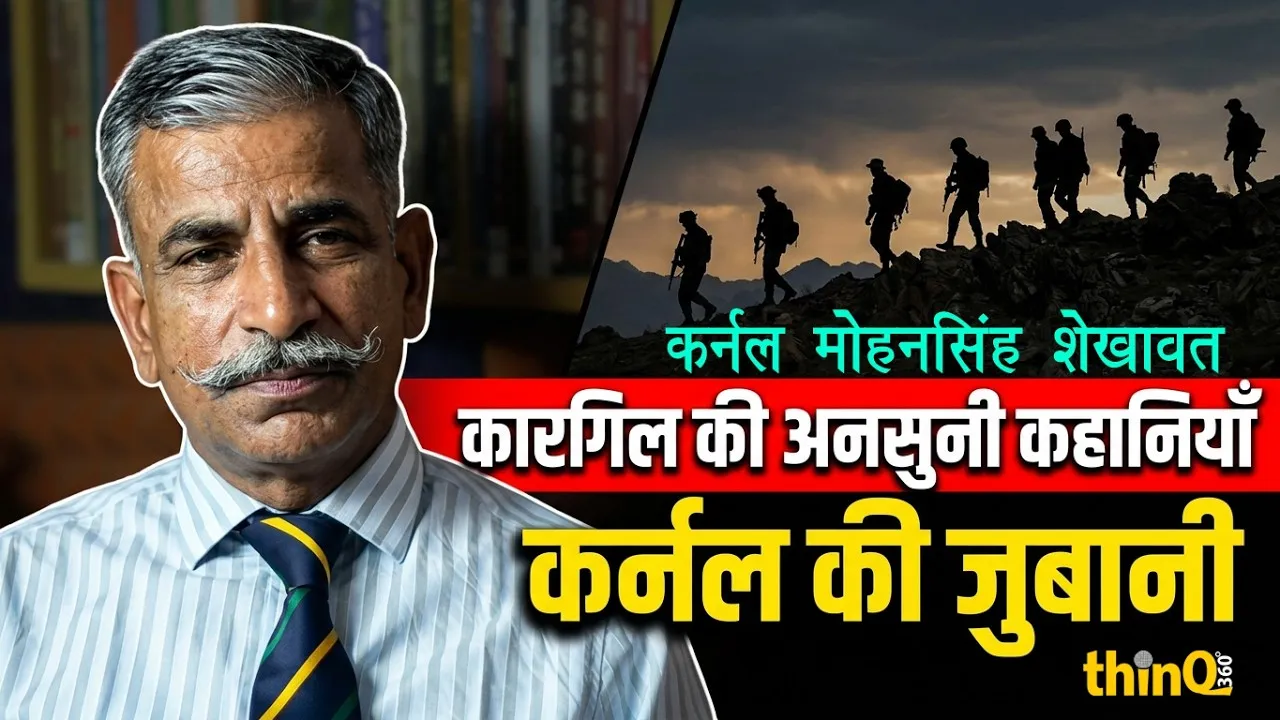
On Kargil Vijay Diwas, Colonel Mohan Singh Shekhawat, from a family with three generations in the army, shared his military experiences, family legacy, and the glorious history of the Jat Regiment.
On the occasion of Kargil Vijay Diwas, we present a special interview with a warrior of the Indian Army, Colonel Mohan Singh Shekhawat, whose family has been serving the nation for three generations. A native of Dhopalia village in Bikaner district, Colonel Shekhawat retired from the Jat Regiment. In this conversation, he shared his military life, family legacy, and experiences of the Kargil War.
He was awarded the 'Order of the British Empire' (OBE) and the 'Indian Distinguished Service Medal' (IDSM) for his bravery, which can be considered equivalent to today's Maha Vir Chakra.
He received a pension for three generations, which was called the 'Jagir Allowance'.
His grandfather fought in several countries like Italy, England, and Mesopotamia. After retirement, his pension was ₹375, a very large sum at that time.
In 1933, he was invited to London for Queen Victoria's coronation. There, Maharaja Ganga Singh Ji of Bikaner saw him and, impressed by his valor, invited him to train the Bikaner army.
Colonel Shekhawat mentioned that his grandfather was illiterate but understood the importance of education.
He spent all his wealth on his children's education. His uncle, Lieutenant General Chiman Singh, was sent to the RIMC, where only princes studied at that time.
His father and other uncle were educated at Noble Public School. Because of this foundation in education, his family today has about 20 army officers, 10 of whom are still serving.
His own son, Major Raghav Singh, is also in the army and chose the forces over an opportunity to pursue an M.Tech abroad.
Colonel Shekhawat did his early schooling in Bikaner. He was a good basketball player and played up to the Junior Nationals.
He completed his 11th and 12th grades at Kendriya Vidyalaya, IIT Chennai, where he received a scholarship.
After that, he came to Delhi University and played for the DU team and the Delhi State team. Immediately after graduation, he joined the army through the CDS.
The Jat Regiment and the 1965 Battle of Dograi
Colonel Shekhawat joined the 3 Jat Regiment, famous for the 'Battle of Dograi' in 1965.
This battle took place in the Dograi tehsil near Lahore. On September 21-22, his unit crossed the Ichhogil Canal without any armored or air support and captured Dograi, just 12 kilometers from Lahore.
He explained that it was a hand-to-hand combat and is considered one of the toughest battles in the world.
He emphasized that you cannot win a war until you physically capture the ground, no matter how advanced the technology becomes.
The Kargil War: A Saga of Indomitable Courage
Speaking on the Kargil War, he said that what the Indian Army accomplished was next to impossible.
The enemy was positioned on about 130 peaks with no natural cover. One enemy soldier at the top could stop 100 soldiers.
The war started in May and ended on July 26. The infantry regiments showed extraordinary bravery.
Small contingents of soldiers moved forward knowing they might not return. They risked their lives solely for the honor of their country and regiment.
India suffered losses in this war, but Pakistan's losses were double.
Pakistan's Deception and India's Response
Colonel Shekhawat explained that Pakistan acted deceitfully in Kargil. There was an unwritten agreement on the Line of Control that both armies would vacate their posts in winter due to 40-50 feet of snowfall.
But Pakistan broke this agreement and positioned its Northern Light Infantry and trained militants in the Indian posts.
Their main objective was to control the Leh-Srinagar National Highway to cut off Ladakh from India.
This deception was discovered when Captain Saurabh Kalia's patrol team went there. The Indian Army took it as a challenge and recaptured all 130 peaks one by one.
Casteism in the Army? 'Nation First'
When asked how he, a Rajput, served in the Jat Regiment, he clearly stated that there is absolutely no casteism in the army.
He recounted an incident when he was in the Uri sector. When a team was being selected for an operation, the Jat soldiers insisted they would only go with 'Mohan Sahab', despite him being a Rajput.
He said, "In the army, there is no religion, no caste. We are all Indians." He expressed deep sorrow over the casteism prevalent in civil administration.
He added that having a regiment named after a caste is a matter of pride, and a soldier fights for the honor of his regiment before his country.
Challenging Operations and Military Honors
Colonel Shekhawat spoke about one of his daring operations. In 1990, he was chosen to lead a patrol to 'Anjankhola Pass' near China, where no one had gone since 1962.
He and his team hoisted the Indian flag there and removed Chinese markers.
Besides this, he conducted several operations in the Kashmir Valley, neutralizing 14 militants in a single operation.
For his bravery, he was awarded the Chief of Army Staff's Commendation three times.
The Changing Army and Civil Society
He mentioned that the army has changed a lot now, with schemes like Agniveer. He said that there used to be a deep bond of love and trust between officers and jawans.
He shared the story of one of his soldiers, Rooparam, who postponed his own wedding because he did not want to leave his platoon during an important competition.
He stated that in the army, the country and the regiment always come before oneself.
Respect for Martyrs
Colonel Shekhawat expressed his sadness that in our country, martyrs and their families do not get the respect they deserve.
He said that soldiers are highly respected abroad, but here, the families of martyrs have to run from pillar to post for small tasks.
He gave an example of a 1971 martyr whose statue has not yet been installed in his village because the school development committee is not giving the NOC.
He stressed that the administration should prioritize the work of martyrs.
Inspiration for Youth and Trust in the Army
Regarding the selection process in the army, he explained that it is based purely on merit. There is no nepotism or political influence.
He said the army needs a cultured child, and children from villages have these values, which is why more of them get selected.
In conclusion, he said that the country has complete faith in its army. In any disaster or crisis, when the army arrives, people are assured that everything will be alright. The army is the nation's last resort and must always be kept strong.

 Pradeep Budawat