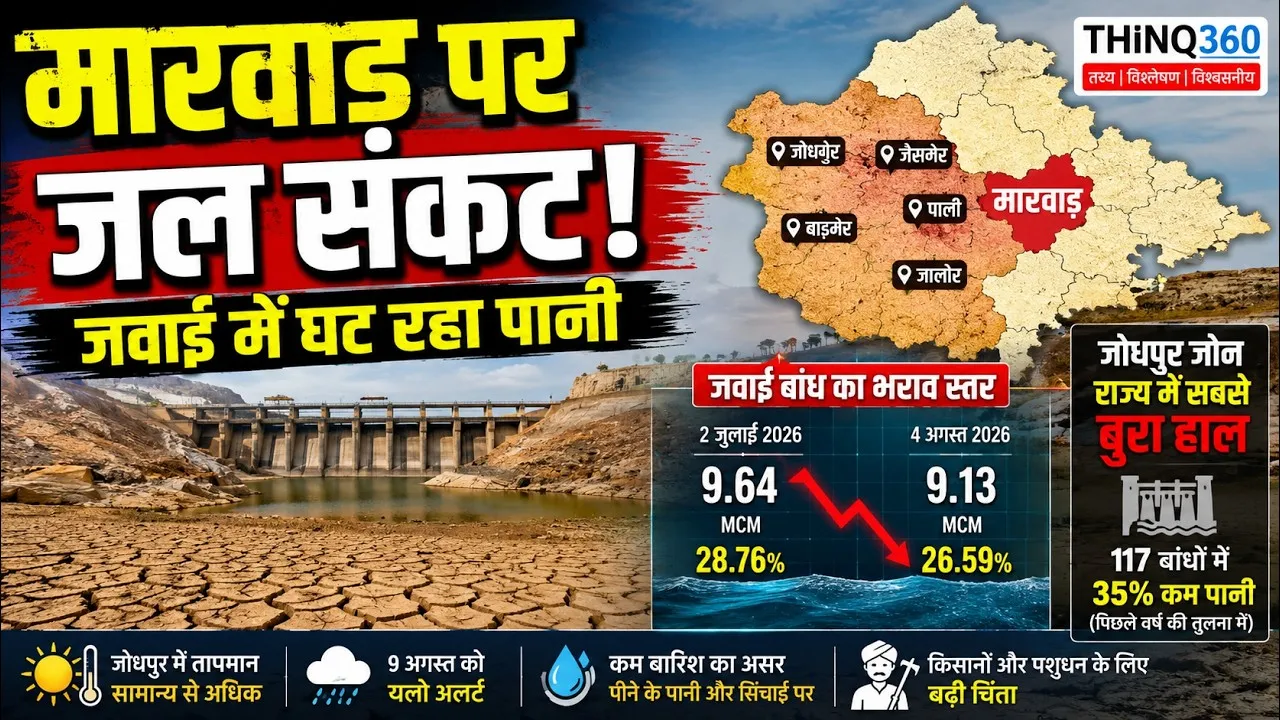
The water crisis in Marwar has deepened due to a lack of monsoon. Temperatures in Jodhpur and Pali are above normal, while the water level of Jawai Dam, the lifeline of Marwar, has further decreased in a month.
Temperature in Jodhpur recorded above normal, with four districts of Marwar among the five hottest in the state.
The water level of Jawai Dam, Marwar's lifeline, dropped from 28.76% to 26.59% in one month.
A sharp decline of 35% in water levels has been recorded in the 117 dams of the Jodhpur zone compared to last year.
The Meteorological Department has issued a yellow alert for good rainfall in several districts of Marwar, including Pali and Jodhpur, on August 9.
Jodhpur | The Marwar region of the Thar has struggled for every drop of water for centuries. But the 2026 monsoon has proven to be the most disappointing for this region so far, deepening the water crisis in districts like Jodhpur, Pali, Barmer, and Jaisalmer.
Weather in Marwar: Dry Sun and Rising Heat
While eastern Rajasthan is drenched in rain, the weather in Jodhpur is completely opposite. On Thursday, the sky here was clear and the sun was bright, making both humidity and heat feel higher than normal.
The maximum temperature here was recorded at 34.9 degrees Celsius, 0.9 degrees above normal, and the minimum temperature was 27.4 degrees Celsius, 1.4 degrees above normal.
The situation in the Marwar-Thar region is even more severe. Four of the five hottest districts in the state are from this area, including Bikaner (38°C), Sri Ganganagar (38°C), Jaisalmer (37.3°C), and Churu (37°C). This shows that the monsoon's grace has not reached this area.
Jawai Dam, located in Pali district, is called the lifeline of Marwar, but its figures this monsoon are alarming. The total storage capacity of the dam is 18.67 million cubic meters.
Water Level Decreased in One Month
On July 2, 2026, the dam had 9.64 million cubic meters of water, which was 28.76% of its capacity. A month later, on August 4, 2026, it decreased to 9.13 million cubic meters, or just 26.59%.
This means that instead of new monsoon water arriving, the already stored water has further decreased. This is a serious sign for the water supply of a large part of Pali and Jodhpur.
Bisalpur Dam, located in Tonk district, is technically part of the Jaipur zone, but it supplies water to the border areas of Marwar via Ajmer.
On July 2, the dam had 313.57 million cubic meters (65.42%) of water, and this figure remained exactly the same on August 4. Not an inch of new water came into the dam in a month, whereas last year at this time it was on the verge of overflowing.
Jodhpur Zone: Worst Situation in the State
According to the Water Resources Department, the Jodhpur zone is in the worst condition among the six dam zones of Rajasthan. This zone includes a total of 117 dams like Jawai, Jaswant Sagar, and Umaid Sagar.
Compared to last year, the water in the dams here has decreased by about 35%, which is the biggest drop among all zones in the state. In comparison, the Jaipur zone has a 29% deficit, Banswara 30%, and Kota zone 13%.
Impact of Water Crisis on the Common Man
Marwar is already a low-rainfall area and is highly dependent on groundwater. Dams like Jawai are the backbone of not only irrigation but also drinking water.
When Jawai Dam is below 26% and there is a 35% drop in the 117 dams of the zone, water rationing and dependence on tankers are bound to increase in the coming months.
Water Resources Minister Suresh Rawat also admitted that the dams are empty due to lack of rain, making it difficult to provide water to farmers. He said that the government will try to provide water through water management.
What's Next: Hope for Rain but Concerns Remain
The Meteorological Department has raised a slight hope. A yellow alert has been issued for good rainfall on August 9 in almost all districts of Marwar, including Pali, Jodhpur, Barmer, and Jaisalmer.
However, according to the India Meteorological Department, New Delhi, below-normal rainfall is expected in Rajasthan even in August-September. In such a situation, the real test for the dams of Marwar is yet to come.

 Pradeep Budawat