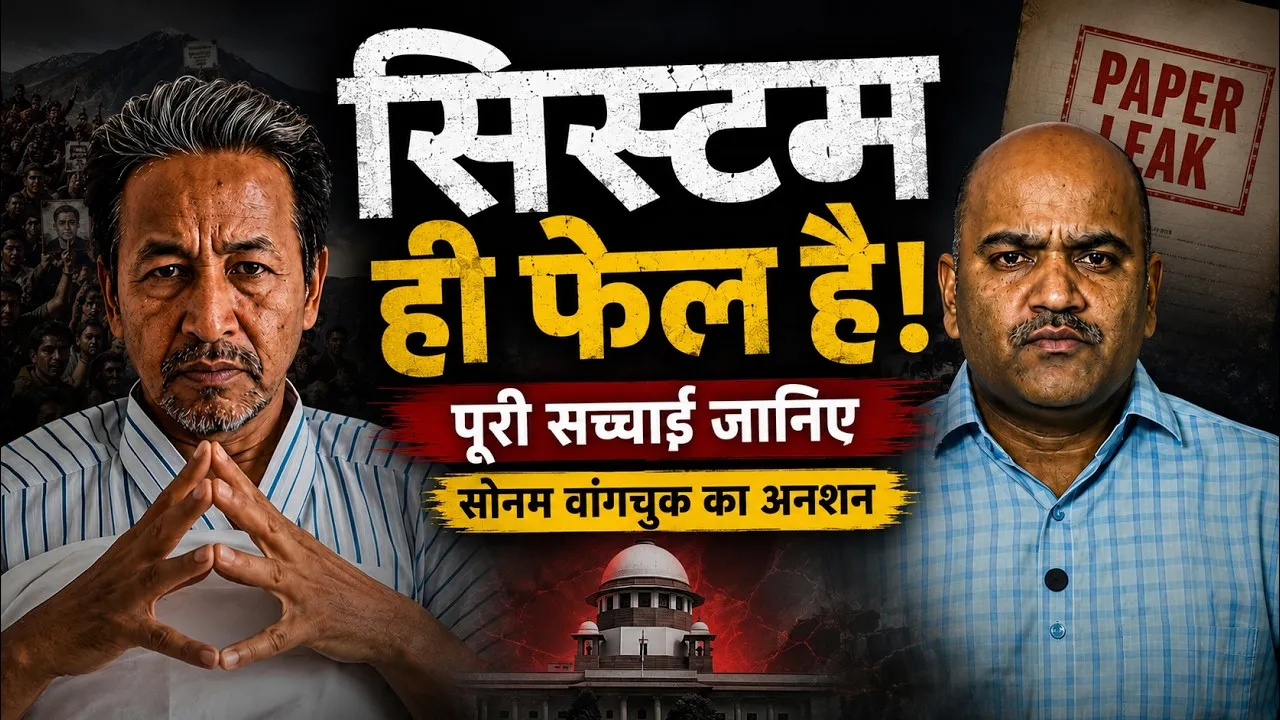
Amidst Sonam Wangchuk's fast, the Education Minister's resignation, and exam fraud, a deep probe into whether our system considers us human or just a statistic.
Sonam Wangchuk undertook a 21-day fast-unto-death for students' rights, after which he was hospitalized.
Under pressure from massive student protests and irregularities in the NEET-UG exam, Union Education Minister Dharmendra Pradhan resigned.
This article raises the question of whether our administrative system considers citizens as living human beings or merely as statistical data.
The analysis also mentions Sonam Wangchuk's grassroots work, such as the 'SECMOL' school and 'Ice Stupas', which form the basis of his moral authority.
Delhi |
This article is not just the story of one individual. It is a fundamental question that perhaps most of us have never asked ourselves—does our administrative and political system see us as living human beings, or are we just a number, a mere statistic to it?
A Movement Reaches the Hospital: The Timeline
First, it is essential to understand the entire timeline of this event in a phased manner, because if you have only seen the newspaper headlines, you probably know only half the truth.
On June 28, 2026, Sonam Wangchuk begins a fast-unto-death in Delhi. This was not a symbolic one-day fast, but a clear message to the system.
His demand had no personal interest. He stood up for the rights of millions of students whose years of hard work were nullified by a single incident of an exam paper leak.
Exams were canceled, serious allegations of fraud were made, and there were even calls for the Education Minister's resignation.
The Echo of Youth Outrage and the Education Minister's Resignation
This demand has now become a historical reality. Under pressure from the irregularities in the exams and the massive youth outrage across the country, Union Education Minister Dharmendra Pradhan has submitted his resignation to the Prime Minister.
In his resignation letter, he clarified that significant irregularities were found in the NEET-UG exam held on May 3, 2026.
The investigation has been handed over to the CBI, and from next year, the exam will be conducted as a computer-based test.
The minister wrote that this step was taken so that 'anti-national forces' do not take advantage of the situation and the unity of the country is maintained.
This resignation is proof that when the youth stand up for their rights, even the highest echelons of power have to be accountable.
Now, imagine the situation of those students who prepare for an exam for years.
And then suddenly, it is revealed that the question paper was already sold in the market. What value is left of that student's hard work?
Sonam Wangchuk gave his voice to this very outrage and deep despair of society.
Days passed, but no concrete response came from the government or administration.
On the 21st day of the fast, July 18, his body began to give up, and he had to be hospitalized.
The situation became so serious that the Delhi High Court had to intervene and order continuous monitoring of his health.
It is worth considering that in a democracy, a citizen has to put his life at stake to make his voice heard.
The Real Issue: This is Not Just a Paper Leak Story
The most important part of this entire article begins here.
Let's assume that from tomorrow, every exam in our country becomes flawless. Would our education system then be considered 'successful'?
The clear answer is—no. And the reason behind this is very deep.
Examination vs. Education
Examination and education—these are two completely different concepts.
An examination selects. Education builds.
The function of an exam is to select one person out of a hundred, while the purpose of education is to help all hundred reach their maximum potential.
Our system has gradually equated these two.
When millions of candidates apply for a single government job, the exam is no longer a measure of talent but becomes a 'rationing system'.
It is a mechanical means of distributing limited opportunities among too many people.
When a young person is left behind in this filtering process, the system tells them to work harder.
But no one questions why sufficient opportunities were not created for everyone.
Slowly, the failure of the system is declared as the individual's personal failure.
Sonam Wangchuk is raising this very question—the discussion should not only be about the paper leak, but about the framework of our entire education and opportunity system.
Moral Authority Born from Action: Who is Sonam Wangchuk?
To understand the seriousness of this issue, it is necessary to know the person who has raised this question.
In 1988, a young engineer arrives in Ladakh. There, he saw that local children, despite being talented, were failing exams.
The reason was that the curriculum was disconnected from their local language, environment, and life.
Seeing this, Wangchuk started an innovative school called 'SECMOL'. His idea was—educate the child within their own environment.
The Invention of Ice Stupas
After this came his most famous invention, the 'Ice Stupa'.
In an arid region like Ladakh, glacier water goes to waste in winter.
Wangchuk froze this winter water into the shape of a conical ice tower.
This tower melts slowly in the summer, providing water for irrigation.
This was the result of a deep understanding of the laws of nature.
For this dedication to society and the environment, he was awarded the 'Ramon Magsaysay Award' in 2018, also known as 'Asia's Nobel Prize'.
His moral authority comes from decades of grassroots work, not just from criticizing on social media.
The 2025 Turning Point: When the Story Isn't Simple
Responsible journalism demands a balanced analysis.
In 2025, a mass movement began in Ladakh demanding full statehood and protection under the Sixth Schedule of the Constitution.
Unfortunately, this peaceful protest turned violent, and some citizens lost their lives.
The government alleged that Sonam Wangchuk's statements incited public sentiment. Wangchuk denied these allegations.
He argued that it was the result of years of accumulated discontent.
After this, the administration detained him under the 'National Security Act' (NSA).
Two Important Questions
Two important questions arise here.
First: Does the government have the right to maintain law and order? Certainly.
Second: Should the government's accusation alone be considered final proof? Absolutely not.
In a healthy democracy, extraordinary laws require concrete evidence.
This is where a worrying trend in contemporary India emerges—we end debates by 'labeling' individuals instead of discussing facts.
Calling someone 'anti-national' or a 'foreign agent' ends any meaningful discussion on the core issue.
This tendency is detrimental to democracy, regardless of which ideology it comes from.
The Question That Belongs to All of Us, Not Just Wangchuk
The true meaning of democracy is not just voting once every five years. It is a continuous dialogue between the government and the public.
The day this dialogue stops, only an 'administrative machinery' remains.
An insensitive system stops seeing humans as people; they become mere statistics.
Records are kept of how many roads were built. But there is no calculation of how many human lives were genuinely changed.
Human elements like dignity, security, and opportunity do not fit into government statistics.
A Direct Question
A direct question to every citizen of the country: Have you ever felt that your legitimate concern is not heard until an extreme step is taken?
If the answer is 'yes', then this is not just your personal problem. It is a question about our entire system.
The hallmark of a true democracy is that the voice of an ordinary citizen is heard based on the strength of their arguments, without any hunger strike.
Human or Statistic at the Center of the System?
It is necessary to understand the essence of this deep subject.
We have before us a person whose reputation is built on selfless hard work.
We have a demand that started with an exam leak but now questions the entire structure of our education system.
And finally, we have a critical question that now belongs not just to Sonam Wangchuk, but to the entire nation.
Sonam Wangchuk's movement will end, governments will change, new policies will be made.
But a fundamental question will always remain—are we building a nation with human sensitivity at its core, or a system where a human is nothing more than a government statistic?
We all must find the answer to this question together.

 Pradeep Budawat