Who Controls How Much of the Market?
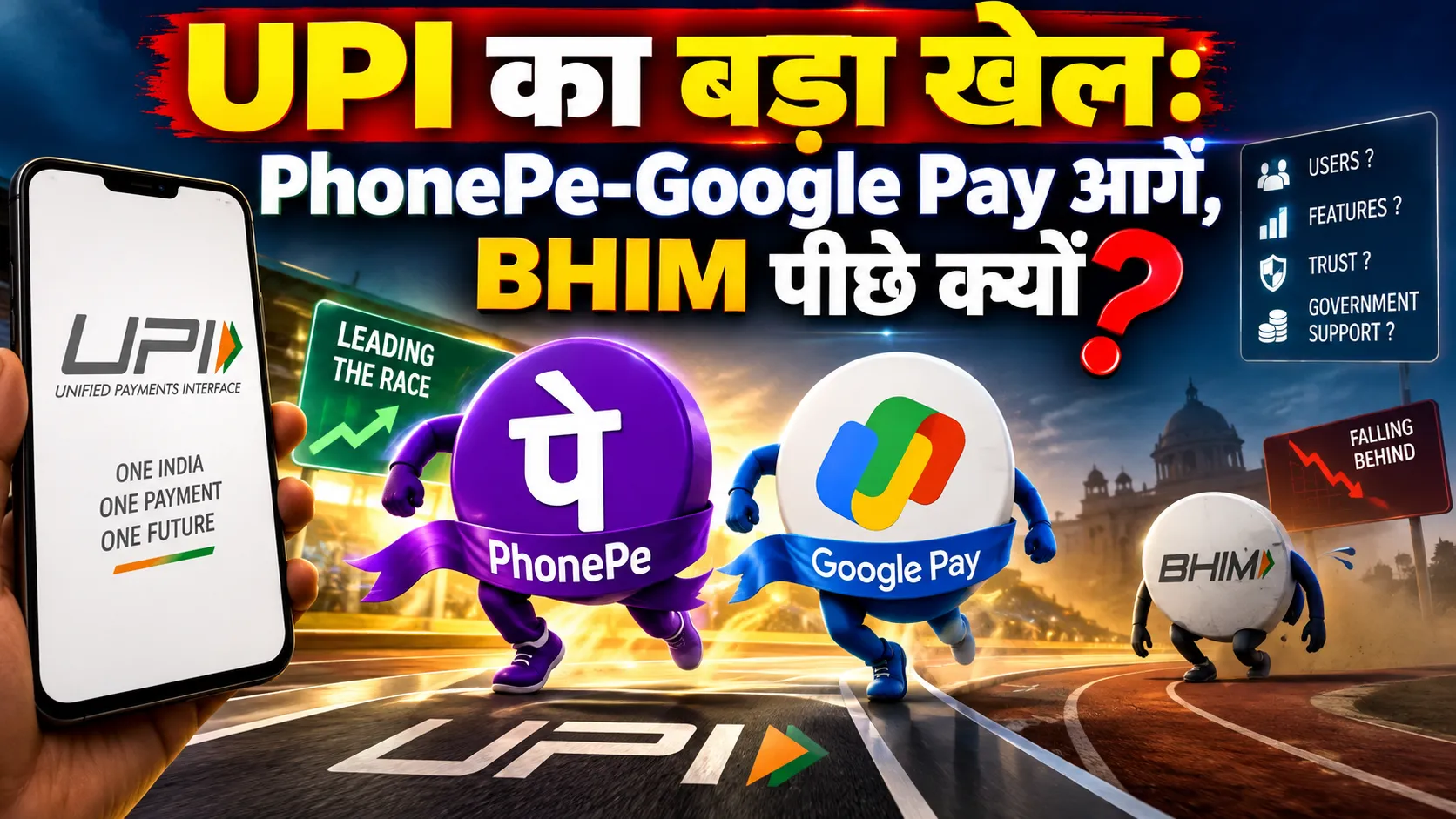
According to NCPI data, in August 2026, nearly 80% of the total transactions via UPI were handled by just two foreign apps - PhonePe and Google Pay.
PhonePe (Walmart) and Google Pay (Alphabet) have established a strong foothold in the Indian digital payments market.
- PhonePe: 45.68% share by volume and 48.61% by value.
- Google Pay: 33.31% share by volume and 33.77% by value.
- Paytm: 7.65% share by volume and 6.42% by value.
- BHIM: 0.79% share by volume and 0.78% by value.
These figures show that even private domestic apps like Paytm are far ahead of the government's BHIM app.
Government's Crores of Aid Also Ineffective
Prime Minister Narendra Modi launched the Bharat Interface for Money (BHIM) app on December 30, 2016. Its objective was to promote digital payments.
But even after ten years, this app has not been able to secure even a one percent share in terms of both volume and value.
Government Incentive Schemes
The Modi government has continuously run incentive schemes to strengthen BHIM-UPI. A scheme of ₹1500 crore was launched for this in the financial year 2024-25.
In the preceding three years, the government had already provided incentives worth about ₹7230 crore. Despite this, the BHIM app has failed to make its mark in the market.
This situation once again raises questions about the failure of government companies in the service sector, much like BSNL-MTNL lagging behind the private company Jio.
Charges on UPI Transactions Reintroduced
A debate has also sparked over charges on UPI payments. From October 15, 2026, a 0.4% charge will be imposed on merchant payments exceeding ₹2000.
This charge will be collected from the merchant, not the customer. Congress MP Rahul Gandhi has opposed it, calling it a 'UPI Tax'.
Why Are Charges Necessary?
Proponents of the charge argue that investment is necessary for the growing infrastructure of digital payments. The amount collected from this charge will help meet this need.
It is estimated that about ₹160-170 billion will be collected, of which 60% will go to banks, 25% to apps, and 15% to aggregators.
This is not the first time a charge has been levied on UPI. In 2016, there was a 0.3% charge, which was later removed. The Merchant Discount Rate (MDR) is already applicable on credit and debit cards.

 जोगेन्द्र सिंह शेखावत