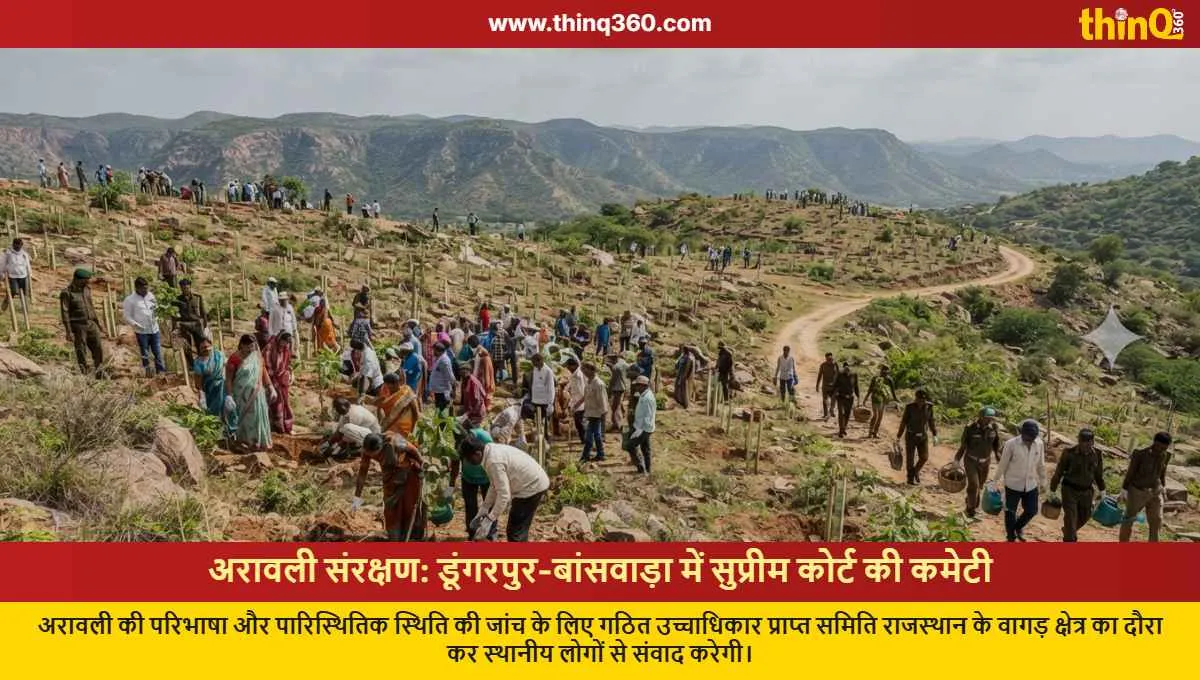
The High-Powered Committee formed by the Supreme Court to study the conservation and definition of Aravali Hills will visit the Vagad region of Rajasthan.
The Supreme Court's High-Powered Committee will visit Dungarpur and Banswara from October 11 to 13.
The committee will conduct a ground study of matters related to the definition, ecological status, and conservation of Aravali.
Direct dialogue will be held with tribal communities and local stakeholders during the visit.
The committee must submit its comprehensive report to the Supreme Court by November 30, 2026.
Jaipur | The High-Powered Committee (HPC) formed by the Supreme Court to investigate matters related to the definition, ecological status, and conservation of the Aravali Hills and Range is visiting Rajasthan once again.
After visiting the Aravali region of Gujarat, the committee will be in Dungarpur and Banswara from October 11 to 13.
This time the focus is on those areas of Vagad where there is a direct link between hills, forests, mining, and the livelihoods of local people, especially tribal communities.
The Deputy Conservators of Forests and field staff of Dungarpur and Banswara will accompany the committee.
Committee to Submit Report
The committee has previously visited Rajasthan for five days. During that time, field visits and dialogues with stakeholders were conducted at various places.
However, it came to light that there was a lack of adequate participation from all concerned parties, especially people from rural and tribal areas.
Following this, a demand arose for a fresh ground investigation and direct dialogue with local people in the southern part of Rajasthan.
The Supreme Court also clarified in its September 7 order that the committee must provide a fair opportunity to all concerned stakeholders, including tribal communities of Rajasthan and Gujarat, to present their views.
The court has directed the committee to submit a comprehensive report by November 30, 2026.
Report to be Prepared Based on Ground Facts
During this visit to Rajasthan, the committee will assess various environmental aspects at selected sites.
The committee will evaluate the following areas:
Mining and quarrying activities
Impact of stone crushers
Land use patterns
Current status of forest areas
Availability and conservation of water sources
Surrounding environmental landscape
Suggestions from Stakeholders
Suggestions will be taken from various groups in meetings held in the evenings in the districts.
The following stakeholders will be included in these meetings:

 बलजीत सिंह शेखावत