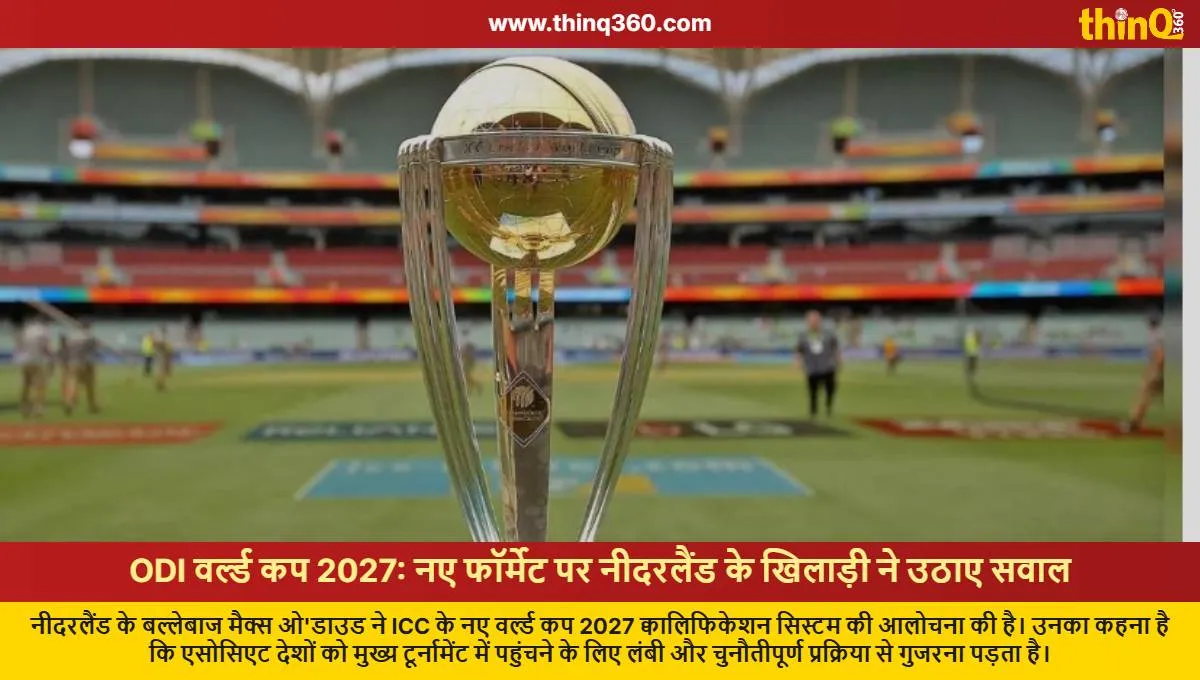
Netherlands batsman Max O'Dowd has criticized the new qualification system for the ICC World Cup 2027, stating it is extremely challenging for associate nations.
Netherlands batsman Max O'Dowd criticized the new World Cup format.
In the 2027 World Cup, 14 teams will compete in three stages.
Associate teams will have to go through a long and difficult process to qualify.
South Africa and Zimbabwe will qualify directly as host nations.
Controversy over the New World Cup Format
Netherlands' star batsman Max O'Dowd has raised serious questions about the qualification process for associate teams for the ODI Cricket World Cup. He has described this process as extremely challenging and disappointing for associate nations.
According to Max O'Dowd, associate countries will have to go through a long and complex process to secure a place in the World Cup, which includes multiple levels of qualifiers.
On Wednesday, the International Cricket Council (ICC) announced a new format for the Cricket World Cup 2027. This new format has sparked a new debate regarding the qualification process.
14-Team Tournament
The ICC Men's Cricket World Cup will continue to feature 14 teams, but the tournament structure has been completely changed.
Three-Stage Competition
The tournament will now be played in three stages, leading up to the final. It includes several new rounds, such as the 'Super Series' and 'Super 7' stage.
How Will This New Format Work?
To understand the new format, it can be divided into three parts. In each stage, teams will have to fight hard to advance to the next round.
At the beginning of the tournament, the three lowest-ranked teams (teams 12, 13, and 14) will participate in Round One, named the 'Super Series'. Only the top team from this round will advance to the main stage.
Round 2: Group Stage
The second round will feature a total of 12 teams. These teams will be divided into two groups of six. Teams in each group will compete against each other.
Super 7 and Semi-finals
The top three teams from each group, along with the next highest-ranked team from both groups, will advance to a new seven-team round-robin stage called the 'Super 7'. The top four teams from this Super 7 stage will qualify for the semi-finals.
How Different is it From the Old Format?
The previous format was quite straightforward. It involved 10 teams that played round-robin matches against each other. After the league stage, the top 4 teams directly advanced to the semi-finals, followed by the final match.
Why Were Questions Raised About the Qualification Process?
Along with the new format, the qualification process has also changed, which has worried the associate nations.
Direct Entry for Host Nations
In this 14-team tournament, South Africa and Zimbabwe will get direct entry as host nations. Additionally, the top 8 teams in the ODI rankings will also be given a direct spot.
The Difficult Path for Associate Teams
For the remaining four spots, teams will have to make their way through the ICC Cricket World Cup League-2 and the subsequent qualifier tournament. Max O'Dowd has raised questions about this very system.
Max O'Dowd Expresses Disappointment
Max O'Dowd stated that under this new system, associate nations will first have to play in an ODI tournament for three years to qualify for the World Cup.
After that, they will have to play a qualifier and then go through another tri-series qualifier. He said that securing a place in the main World Cup after such a lengthy process is very disappointing and challenging for any team.
Netherlands' Performance in the World Cup
It is noteworthy that the Netherlands team has participated in the ODI World Cup five times so far. The team first qualified for the World Cup in 1996.
Following that, the team also consistently made it to the 2003, 2007, and 2011 World Cups. However, it failed to qualify for the 2015 and 2019 editions.
In the last tournament, the ODI World Cup held in 2023, the Netherlands qualified and also caused the biggest upset by defeating South Africa. However, the team has never been able to advance beyond the group stage.

 जोगेन्द्र सिंह शेखावत