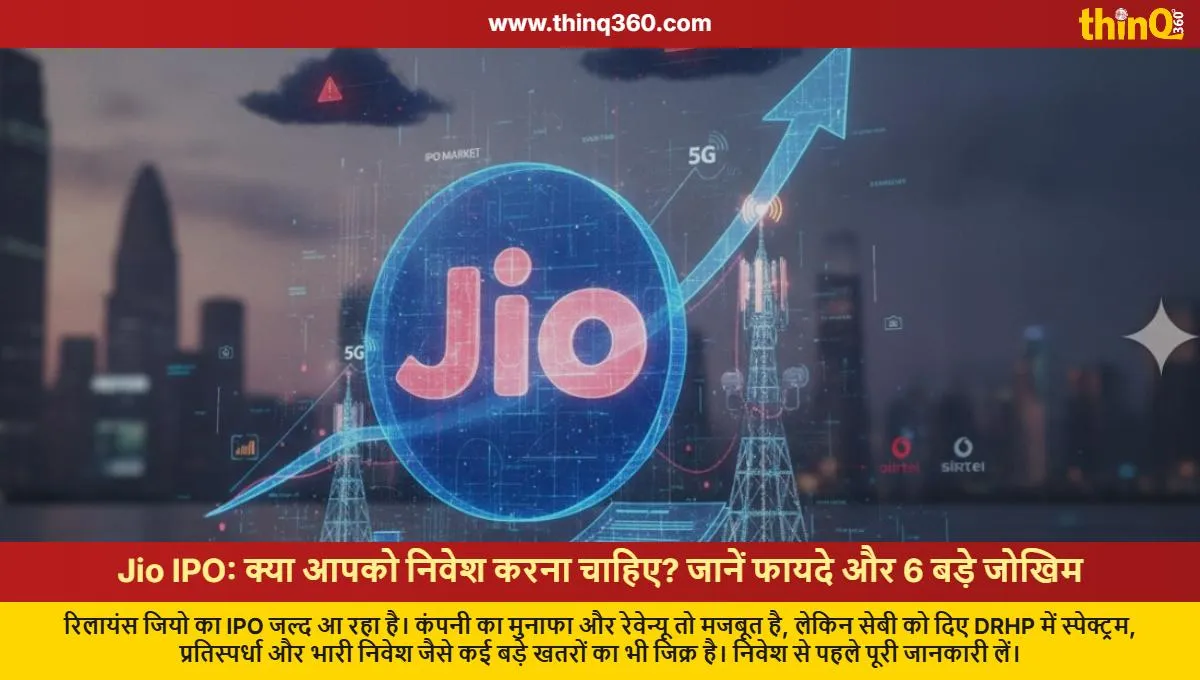
Jio's profit and revenue grew by 13% in the March quarter to ₹7,935 crore and ₹44,928 crore, respectively.
The company plans to issue 27 crore new shares under the IPO, potentially making it the country's largest issue.
The company has listed the challenge of acquiring spectrum and heavy capital expenditure as major risks in the DRHP.
Jio faces continuous stiff competition from Airtel and Vodafone Idea in the Indian market.
Mumbai | Reliance Group's digital and telecom company, Jio Platforms, has filed its Draft Red Herring Prospectus (DRHP) with the market regulator SEBI for its IPO. This IPO could become the largest public issue in the country's history. While the company's financial results are impressive, profit isn't everything for investors. Jio itself has mentioned certain risks in its prospectus that are important to consider before investing.
Know These 6 Major Risks Before Investing
Jio reported an operating revenue of ₹44,928 crore in the March quarter of FY 2025-26, a 13% increase. Similarly, the net profit also rose by 13% to ₹7,935 crore. Despite these strong figures, some challenges could affect the company's performance in the future.
1. The Challenge of Acquiring Spectrum
Spectrum is the most critical resource for the telecom business. Adequate spectrum is essential to provide good network quality and high-speed internet to customers.
The government auctions spectrum, where prices are continuously rising. If Jio fails to acquire the necessary spectrum in the future or if competitors outbid them, it could directly impact its services and customer growth.
2. Network Expansion and Heavy Capital Expenditure
Jio is investing heavily in the expansion of its 5G network and other digital services. The company incurred a capital expenditure (Capex) of approximately ₹34,184 crore in FY 2025-26.
Technology changes rapidly in the telecom sector. Thus, there is no guarantee that every investment will yield the expected returns. If the return on investment is weak, it could put pressure on the company's financial health.
3. Over-dependence on Select Suppliers
For its network equipment, Jio relies on a limited number of select suppliers, most of whom are foreign companies.
If any supplier faces production, technical, or logistical issues, the pace of Jio's network expansion could slow down. Furthermore, global tensions or any disruption in the supply chain could also affect the company's operations.
Market experts believe that, 'Jio's growth story is strong, but the inherent volatility and regulatory risks of the telecom sector cannot be ignored.'
4. Stiff Competition from Airtel and Vodafone-Idea
The Indian telecom market is one of the most competitive in the world. Although Jio leads in subscriber base, it faces continuous stiff competition from Bharti Airtel and Vodafone Idea.
If competitors introduce more attractive tariff plans, better services, or new offers, it could negatively impact Jio's customer base and market share.
5. Dependence on Tower and Fiber Infrastructure
Jio's network operations are largely dependent on a few select infrastructure partner companies. The company uses millions of towers, a significant portion of which is owned by a single partner.
Similarly, for its fiber network, the company relies on a few collaborators. If these partner companies face any financial, technical, or legal problems, Jio's services could be disrupted.
6. Strict Regulatory Framework and Compliance Risk
Telecom is one of the most heavily regulated sectors in India. Jio must comply with the strict regulations of the Telecom Regulatory Authority of India (TRAI) and the Department of Telecommunications (DoT).
Even a minor mistake in matters like licensing, spectrum, customer verification, and data security can lead to heavy fines or sanctions, which can affect the business.
In conclusion, Jio's IPO comes with immense growth potential, but investors must carefully evaluate these six key risks. The company's future success will heavily depend on its ability to navigate these challenges effectively.

 जोगेन्द्र सिंह शेखावत