What is the new rule and when will it be effective?
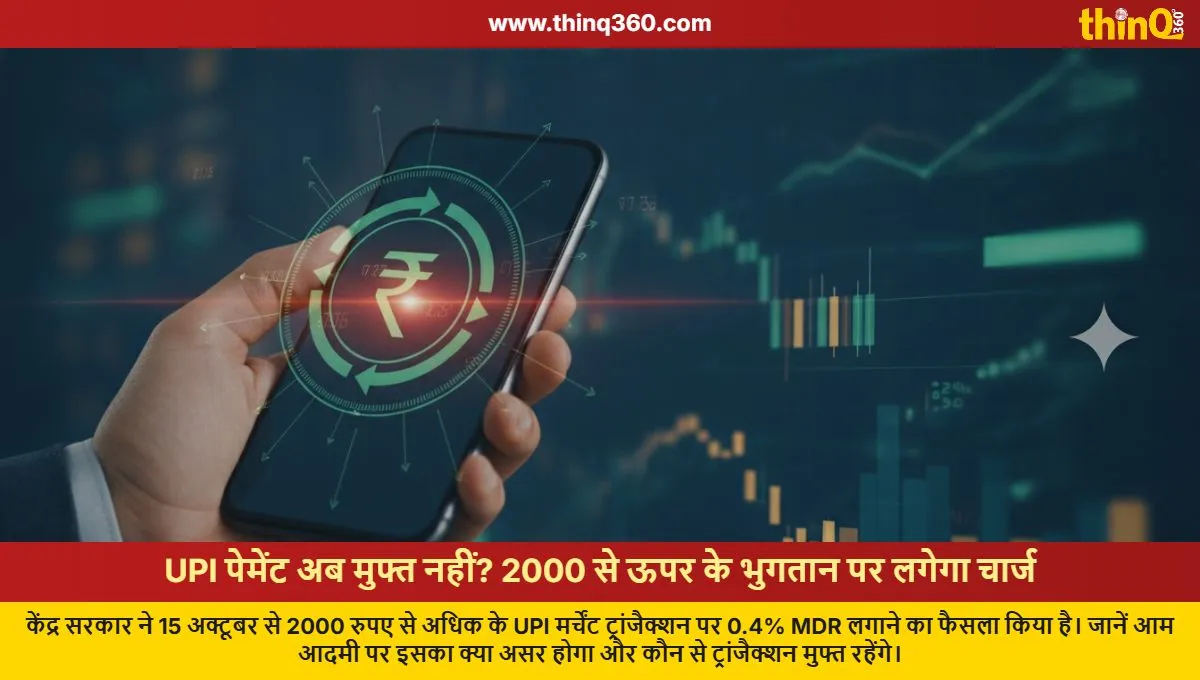
According to the decision made in the meeting, a charge of 0.4 percent will be levied on merchant payments exceeding ₹2,000. The government has set the maximum limit for this charge at ₹300, so that even large transactions do not place an excessive burden on businesses.
These new rules will come into effect nationwide from October 15. After this, all merchant transactions exceeding the specified limit will fall under the purview of this new charge.
Relief for the common people
The government has clarified that this new rule will have no direct impact on the general public. No fee will be charged for any amount in person-to-person (P2P) payments.
This means you can continue to send money to your friends, family, or any other individual without any additional cost, just as before. UPI will remain completely free for ordinary citizens.
Which businesses will be affected?
This charge will only apply to payments related to merchants, i.e., shopkeepers and businesses. When a customer makes a payment of more than ₹2,000 to a shopkeeper via UPI, this MDR will be applicable.
Special rates for certain sectors
Providing relief to some essential service sectors, the government has set different rates for them. In these categories, a flat MDR of ₹5 will be charged on transactions exceeding ₹2,000. These include:
- Railways
- Telecom
- Insurance
- Fuel (Petrol, Diesel)
- Agri Inputs
These sectors account for approximately 17 percent of the total merchant transaction volume and about 46 percent of the value.
Different rules for financial markets
Meanwhile, payments made to mutual funds, securities, stock brokers, and dealers will attract an MDR of 0.02 percent, with a maximum cap of ₹300. The government's objective with this step is to promote retail participation in the formal financial market through digital payments.
Why did the government make this decision?
The government states that UPI has now become a very large network, requiring significant resources for its safe and smooth operation.
Continuous investment is needed for cybersecurity, fraud prevention, and constant innovation in the system. According to the government, relying solely on government subsidies is not feasible in the long run. For this reason, a plan has been devised to create a fund through MDR.
The growing scope of UPI
Launched on August 25, 2016, UPI has revolutionized India's digital payment system. While the transaction value was ₹0.07 lakh crore in FY 2017, it has grown to about ₹314 lakh crore in FY 2026.
According to data, 96 percent of payments in the country are within the limit of ₹2,000. On the other hand, transactions above ₹2,000, despite being only 4 percent in number, constitute 66 percent of the total payment value.
Will there be an indirect impact on customers?
Although the government has stated that this charge will not be collected directly from customers, experts believe that businesses might pass on their increased costs to consumers.
It is possible that they may slightly increase the prices of their goods or services, which could indirectly affect the pockets of the general customers as well.

 बलजीत सिंह शेखावत