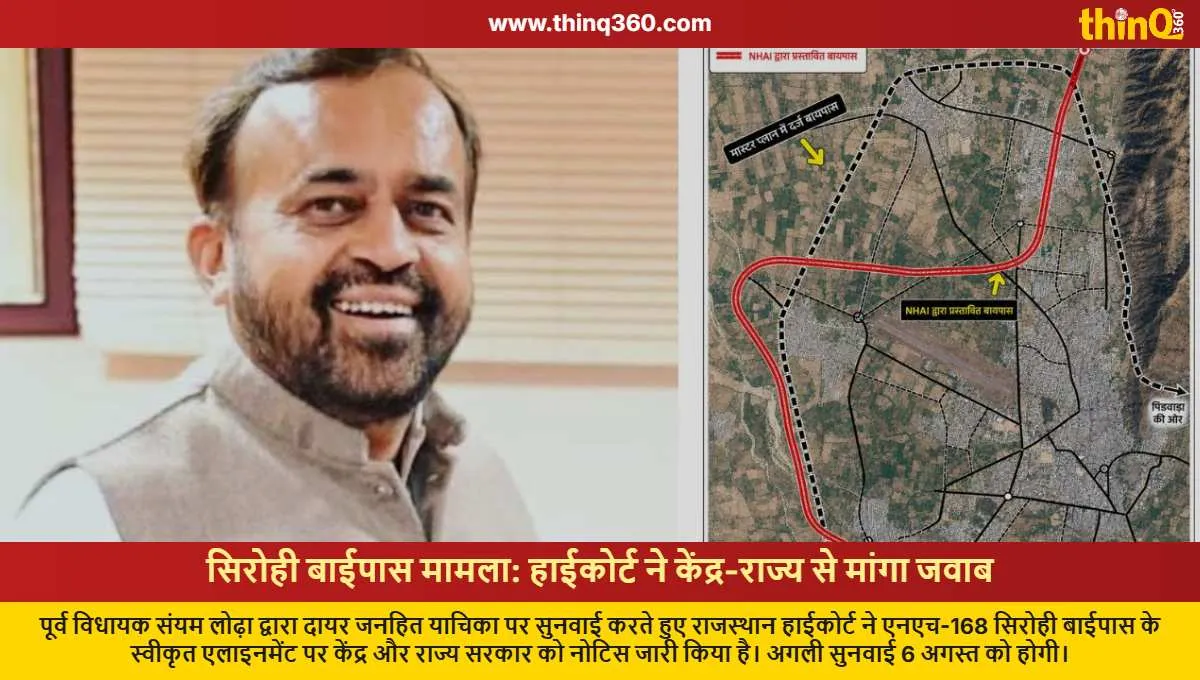
A hearing was held in the High Court regarding the approved alignment of the Sirohi bypass. On the petition of former MLA Sanyam Lodha, the court has sought a reply from the Centre and State. The next hearing is on August 6.
The matter concerning the alignment of the proposed Sirohi bypass on NH-168 has now reached the RajasthanHigh Court. Hearing a Public Interest Litigation (PIL) filed by former MLA Sanyam Lodha, the court has sought a response from the Central and State governments.
The next hearing in this important case is scheduled for August 6, 2026, where the governments will have to present their side.
This PIL has been presented by advocate Rajesh Shah on behalf of former MLA Sanyam Lodha.
A division bench of Justice Pushpendra Singh Bhati and Justice Praveer Bhatnagar of the Rajasthan High Court heard the matter and issued notices to the concerned parties.
What is the whole issue?
The petition challenges the alignment (Option-4) approved by the Ministry of Road Transport and Highways for the Sirohi bypass of NH-168.
The petitioner argues that this alignment is against the public interest and will adversely affect the planned development of the city.
The petitioner has claimed that Option-5 is not only less expensive but also affects a significantly smaller number of people.
It will provide better road safety and offer a more convenient bypass to the public.
Major Difference in Cost
The petition also provides a comparative detail of the costs of both options.
Option-4: The estimated cost for bypass construction is approximately ₹158 crore, and for the entire project, it is around ₹303 crore.
Option-5: The cost of bypass construction is about ₹83 crore, and the estimated cost for the entire project is ₹249 crore.
Was the Officials' Report Ignored?
The petition also mentions that departmental officials and the Union Minister were informed of the actual facts.
The comparative report prepared by the officials also favored Option-5. Despite this, the ministry started work on Option-4, which is described as being against the principles of good governance.
The Importance of the Master Plan
The petition, filed under Article 226 of the Constitution, cites a Supreme Court judgment, stating that a Master Plan is not just an administrative guideline but a binding official document that must be followed.
All eyes are now on the next hearing on August 6, when the Central and State governments will file their replies in the matter.

 गणपत सिंह मांडोली