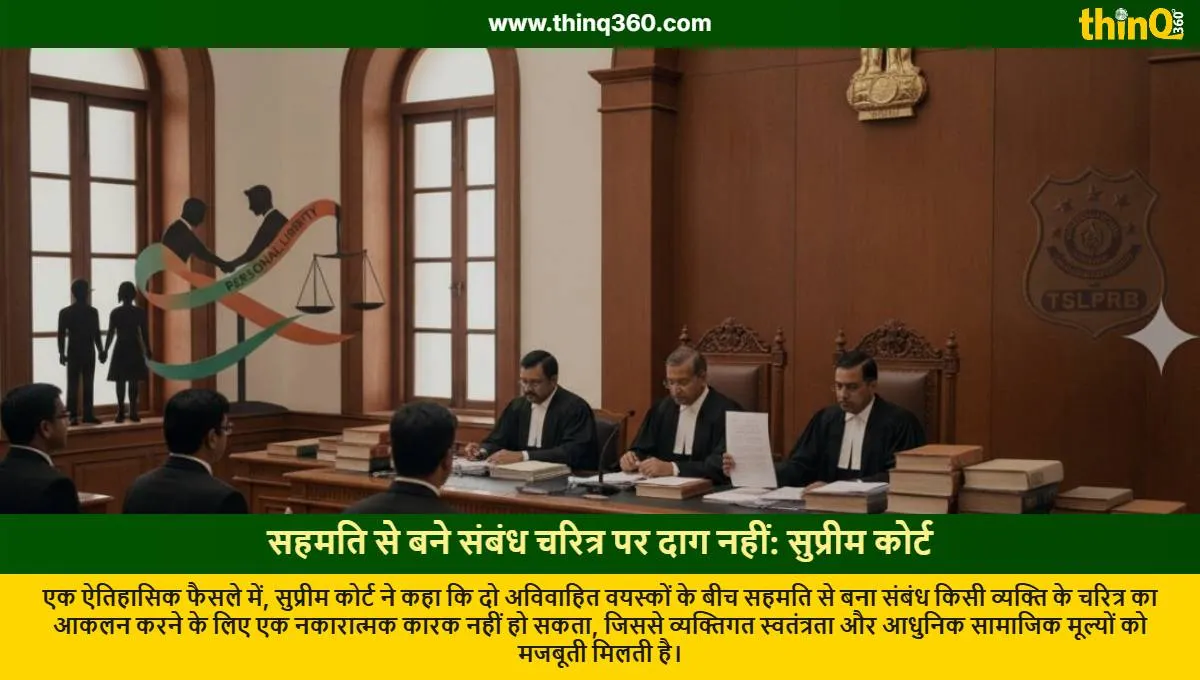
SC stated that a consensual relationship cannot be the basis for commenting on someone's character.
The court acknowledged that not every relationship must culminate in marriage.
The verdict came in a case related to police constable recruitment in Telangana.
The court provided relief to the candidate by quashing the decision to cancel his appointment.
New Delhi | The Supreme Court has delivered a landmark judgment on personal liberty and evolving social relationships. The court clarified that a consensual physical relationship between two unmarried adults cannot be a basis for questioning someone's character. This observation was made in a case related to Telangana police recruitment.
Changing Social Norms and Personal Freedom
The bench of Justice Manmohan and Justice Manoj Misra heard the case. The court stated that social conditions in India are changing rapidly.
The bench emphasized that relationships among the youth cannot be viewed through an old and narrow lens. This decision reflects modern thinking.
The court also clarified that it is not at all necessary for every relationship to culminate in marriage.
Just because a relationship did not turn into marriage, neither party can be considered deceitful or immoral.
According to the court, "A long-term relationship between two unmarried adults will be considered a sign of general consent."
The law gives any two consenting adults complete freedom to form a relationship of their choice. This verdict has further strengthened the right to personal dignity and liberty.
The Telangana Police Recruitment Case
This entire case was related to the Telangana State Level Police Recruitment Board (TSLPRB). A candidate was selected for the post of Stipendiary Cadet Trainee Police Constable.
However, his appointment was canceled due to a criminal case filed in 2014. The case was related to an allegation of having a relationship on the false pretext of marriage.
Settlement is Not an Admission of Guilt
However, the matter was later settled between the two parties in a Lok Adalat in 2015. The candidate had disclosed this case in his application form.
The Supreme Court said that a settlement in the Lok Adalat does not mean that the person has admitted their guilt.
The bench stated that to prove fraud, it was necessary to show that the woman was intentionally deceived, for which no concrete evidence was found.
The court also found no evidence of any pressure or threat on the complainant, and she herself did not pursue the case further.
In conclusion, the Supreme Court quashed the recruitment board's decision to cancel the appointment. This decision has provided great relief to the candidate and set an important precedent for the future, emphasizing the separation of personal relationships and professional life.

 बलजीत सिंह शेखावत