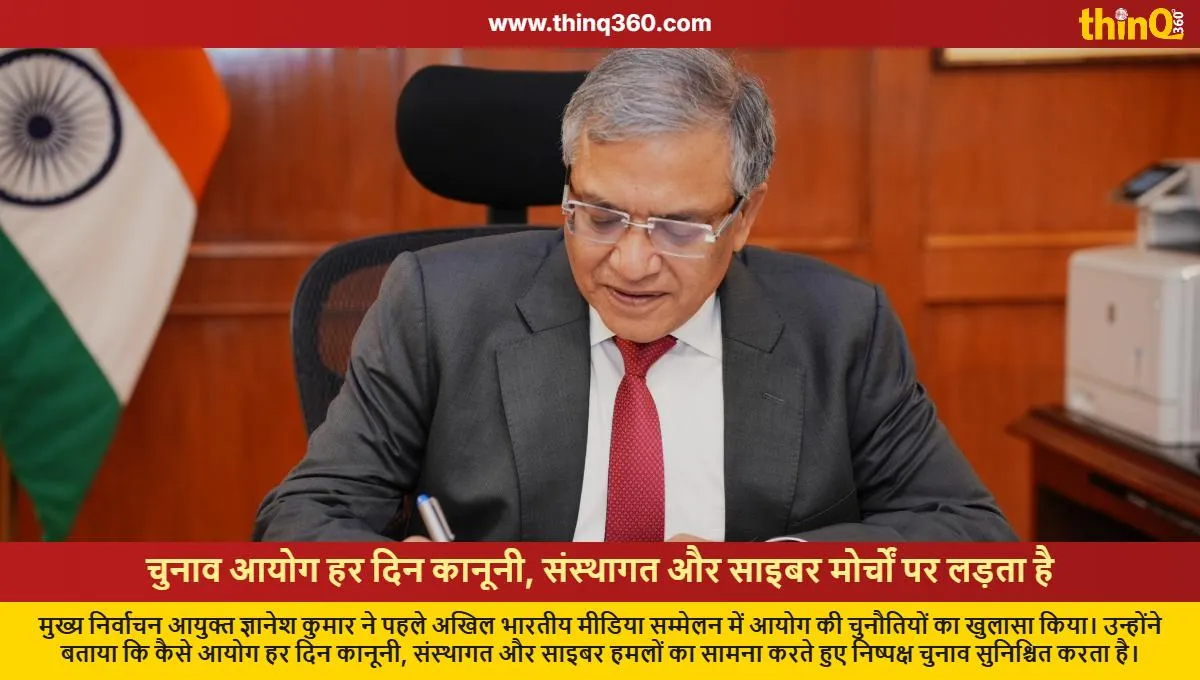
At the first All India Media Conference, CEC Gyanesh Kumar said the commission fights daily on legal, institutional, and cyber fronts, and has won 785 out of 786 court cases in the last year.
Chief Election Commissioner Gyanesh Kumar said that the Election Commission fights on legal, institutional, and cyber fronts every day.
The commission faced 786 legal cases in the past year, winning 785 of them.
India's electoral roll with 95 crore voters is a 'living document' that is constantly updated.
The CEC clarified that there is currently no proposal for online voting as it is not provided for in the Constitution.
Delhi |
'A little heart is needed... a little courage too.' As soon as Chief Election Commissioner (CEC) Gyanesh Kumar said this sentence at the first All India Media Conference held in Delhi, the eyes of the journalists present in the auditorium were fixed on him.
This was not just an emotional comment, but the essence of the daily challenges faced by the Election Commission and the electoral reforms of the past year.
He clearly stated that conducting elections in the world's largest democracy is not just an administrative responsibility, but a battle fought on many fronts every day.
First National Conference on 'Role of Media in Elections'
More than 380 media representatives from states and union territories across the country participated in this conference on the theme 'Role of Media in Elections'.
This was the first such national-level event by the Election Commission of India (ECI).
Its purpose was stated to be to create a better understanding among journalists about the electoral process, its transparency, and the role of the media in it.
The program began with an understanding of the election process under the Constitution, the Representation of the People Act-1950 and 1951, and the guidelines issued by the Commission from time to time.
Journalists at the conference were also shown a live demonstration of processes like the preparation of the voter list, polling, and counting of votes.
The aim was to help them understand the statutory forms and methods used in these processes closely. The event concluded with a question-and-answer session between the journalists and the CEC.
'We face personal attacks, cyber attacks too'
In his address, Gyanesh Kumar said that elections in India are conducted in accordance with the Constitution, the Representation of the People Act, and the instructions issued by the Commission.
He said that the entire electoral process undergoes parallel monitoring and auditing, so there is no room to question its transparency and credibility.
Refusing to limit the role of the commission to just conducting elections, he said, 'We face personal attacks, institutional attacks, and cyber attacks too... whether it's a storm or a tempest... we continue to do our work within the ambit of the Constitution.'
During the discussion, the CEC's message was clear that the Election Commission is committed to conducting fair and credible elections while fulfilling its accountability to the Constitution, despite criticism, legal challenges, and all kinds of attacks.
786 court cases in one year, Commission wins 785
The CEC also shared data on the legal challenges faced by the commission.
He stated that in the past year, the commission had to face 786 legal cases, out of which the courts ruled in favor of the commission in 785 cases.
He termed this as a kind of 'legal battle' that the commission fights in the courts every day.
SIR: A 'living' list of 95 crore voters
Referring to the Special Intensive Revision (SIR), the CEC said that its purpose is only to update and make the voter list error-free.
Under this process, the names of dead, shifted, duplicate, or ineligible voters are removed from the list.
He said that India's electoral roll with about 95 crore voters is a 'living document' that is constantly being updated.
More than 1.2 million Booth Level Officers (BLOs) and over 1.5 million Booth Level Agents (BLAs) work as parallel auditors in its preparation.
He described the record turnout in the recent assembly elections as proof of the Indian voters' trust in the electoral system.
Opposition's questions and the Commission's stance
It is noteworthy that opposition parties, especially the Congress and the Leader of the Opposition in the Lok Sabha, Rahul Gandhi, have been continuously raising questions about the SIR.
After allegations of 'vote theft' regarding the Mahadevapura seat in Bengaluru, the CEC had challenged the opposition in August to file a complaint with an affidavit within seven days.
Recently, the Supreme Court has also upheld the commission's right to conduct SIR. In this context, the CEC's comments at the media conference are considered significant.
Commission's stance on Online Voting and CCTV
Gyanesh Kumar also clarified that there is currently no proposal under consideration to introduce online voting, as there is no provision for it in the Constitution.
On the demand for installing CCTVs in polling booths, he said that doing so would affect the constitutional provision of secret ballot, hence it is not possible.
CEC's jibe at media criticism
Taking a jibe at sharp media criticism, the CEC said that just as the sun always rises in the east, the commission always works within the framework of the Constitution.
He narrated an anecdote about how the media showed the sun rising from different directions, and each time he had to explain that the sun rises only from the east.
On this, the CEC said that it was considered better to let the sun do its work rather than repeating the same thing over and over.
Who is Gyanesh Kumar?
Gyanesh Kumar is a 1988 batch IAS officer of the Kerala cadre. He became the 26th Chief Election Commissioner of the country in February 2025.
He is the first CEC to be appointed under the new law 'The Chief Election Commissioner and other Election Commissioners (Appointment, Conditions of Service and Term of Office) Act, 2023'.
His tenure is until January 26, 2029. Before this, he was a Joint Secretary in the Kashmir Division of the Union Home Ministry and played a key role in the preparations for the abrogation of Article 370.
A history of controversies and the Commission's clarifications
Gyanesh Kumar's tenure has been surrounded by controversies and questions from the beginning, and each time he or the commission has retaliated with their side of the story.
Rahul Gandhi's 'vote theft' allegations
In August 2025, Rahul Gandhi, citing seats in Karnataka and Maharashtra, had alleged 'vote theft'.
In response, the CEC held a press conference, calling the allegations baseless and asking the complainant to come forward with an affidavit.
Allegations of SIR and 'conspiracy to steal votes'
During the SIR in Bihar, the opposition called it a 'conspiracy to steal votes'. The CEC responded by saying that some parties are doing politics by putting the gun on the commission's shoulder.
Criticism from former Election Commissioners
Former CECs S.Y. Quraishi and O.P. Rawat had criticized the CEC's aggressive stance, saying that the commission's job is to clear doubts, not ask questions.
Deletion of names from Delhi's voter list
The Aam Aadmi Party had accused Gyanesh Kumar of not acting on complaints about the deletion of names from the voter list in Delhi, which the commission denied.

 जोगेन्द्र सिंह शेखावत