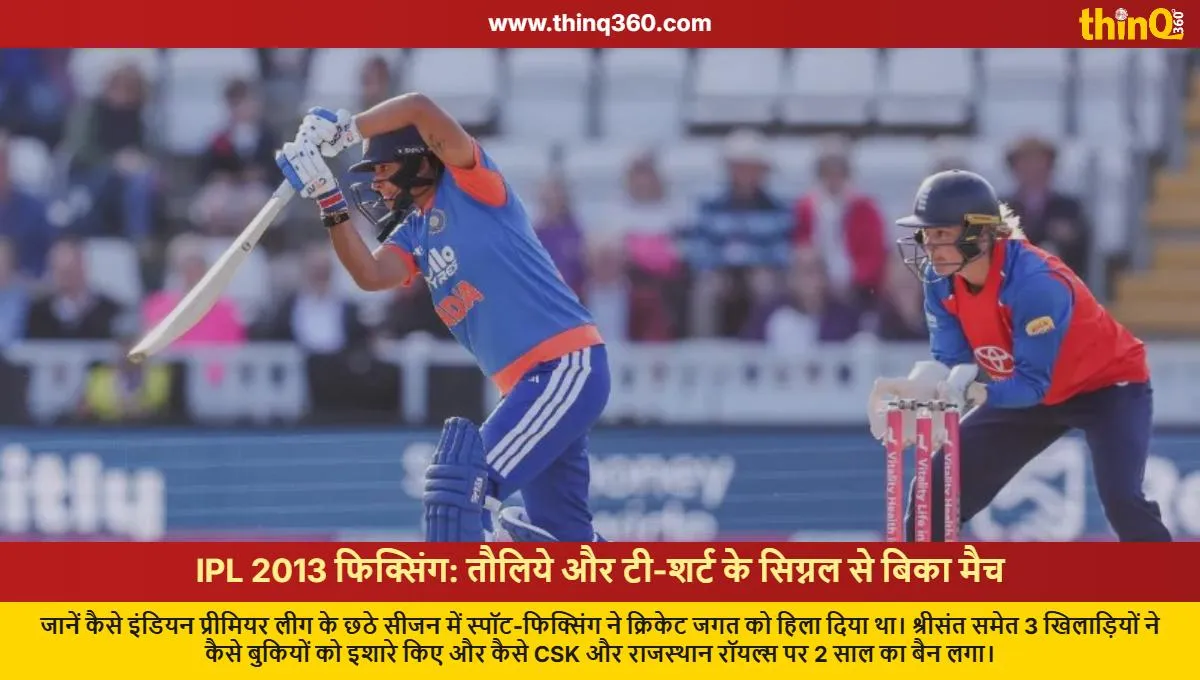
In 2013, 3 Rajasthan Royals players were arrested for spot-fixing.
Players used signals like tucking a towel and pulling t-shirts to alert bookies.
CSK's Team Principal, Gurunath Meiyappan, was also found involved in betting and leaking information.
Following the scandal, the CSK and Rajasthan Royals franchises were banned for 2 years.
New Delhi |
The Indian Premier League (IPL) changed Indian cricket forever. But in 2013, the league was hit by a scandal that shook the cricketing world. It was the sixth season of the IPL when the genie of spot-fixing came out of the bottle, implicating several big names.
This story was not limited to the arrest of a few players; it raised serious questions about the teams, owners, and the entire cricket ecosystem. The scandal showed how the spirit of the game could be sold for a small amount of money.
The morning of May 16, 2013, brought shocking news for cricket fans. In a press conference, the Delhi Police revealed that they had arrested three Rajasthan Royals players on charges of spot-fixing.
These players included World Cup-winning fast bowler S. Sreesanth, Ajit Chandila, and Ankeet Chavan. The news created a sensation in the cricket world. No one could believe that players who had represented the country at the international level could do such a thing.
How Was the Spot-Fixing Scandal Uncovered?
The Delhi Police stated that they had been monitoring a network of bookies for some time. Through phone tapping and surveillance, they discovered that spot-fixing was taking place in IPL matches, with players also involved.
In this operation, the police also arrested 11 bookies. The investigation also revealed that a former Rajasthan Royals player, Amit Singh, was acting as a middleman between the bookies and the players.
The most interesting aspect of the investigation was how the players signaled the bookies. It was no less than a movie script. The police revealed the 5 key signals used to carry out the fixing.
It was a completely pre-planned scheme. It was pre-decided how many runs a player had to concede in a particular over. Just before the over began, the player would give a specific signal so that the bookies sitting outside the ground could place their bets on that over.
The Towel Game: The Most Common Signal
Sreesanth was accused of fixing in a match against Punjab Kings in Mohali. He was supposed to concede more than 14 runs in one over. He received around 40 lakh rupees for this.
To give the signal, Sreesanth had tucked a small towel in his trousers. Before bowling the fixed over, he took the towel out for a moment and then put it back. This was the signal for the bookies that it was time to place bets.
Another common signal was to perform unnecessary warm-ups or stretching just before an over. The bowler would pretend to set his watch or rotate his wrist. This might seem normal, but it was actually a code for the bookies.
Other Clothing-Related Gestures
Players also used gestures like lifting their t-shirts up and down or fiddling with a locket. Ajit Chandila was accused of signaling the bookies by lifting his t-shirt. All these signals were also captured on camera, which later became crucial evidence for the police.
Ajit Chandila's Mistake and the 60 Lakh Rupee Case
An interesting incident also came to light in this scandal. In a match against Pune Warriors India in Jaipur on May 5, 2013, Ajit Chandila was offered 60 lakh rupees to concede 14 or more runs in an over.
Forgot the Signal, Bookies Demanded Money Back
Everything was set, but Chandila forgot to give the pre-decided signal before starting the over. Because of this, the bookies couldn't place their bets on that over. After the match, the bookies demanded their money back from Chandila, leading to a heated argument. This conversation was also recorded by the police.
The Investigation Reaches Chennai Super Kings
This case was not limited to the Rajasthan Royals. As the investigation progressed, its heat reached the two-time champion team, Chennai Super Kings (CSK).
Arrest of Gurunath Meiyappan
On May 24, 2013, the Mumbai Police arrested CSK's Team Principal and son-in-law of the then BCCI President N. Srinivasan, Gurunath Meiyappan, on charges of betting, conspiracy, and fraud.
Meiyappan was accused of leaking inside team information to bookies and betting on matches himself. Initially, CSK tried to distance itself from Meiyappan, calling him just an 'honorary member,' but the investigation proved he was a key team official.
The Bollywood Connection and Vindu Dara Singh
A Bollywood connection also emerged in this case when actor Vindu Dara Singh was arrested. Vindu was accused of facilitating contact between Meiyappan and the bookies. This arrest exposed the dark nexus between glamour and cricket.
BCCI's Action and the Ban on Teams
The entire scandal tarnished the reputation of the BCCI. Under pressure, the BCCI had to take strict measures. The board formed its own disciplinary committee.
Life Ban on Players
In September 2013, the BCCI imposed a life ban on S. Sreesanth and Ankeet Chavan. A long ban was also imposed on Ajit Chandila. Amit Singh was banned for 5 years, and Siddharth Trivedi was banned for 1 year for not reporting the approach, despite testifying.
Lodha Committee's Recommendations and the 2-Year Suspension
Given the seriousness of the matter, the Supreme Court intervened and formed the Justice Lodha Committee. In its investigation, the committee found Gurunath Meiyappan and Rajasthan Royals co-owner Raj Kundra guilty of betting.
In July 2015, the Lodha Committee delivered a landmark verdict, suspending the Chennai Super Kings and Rajasthan Royals franchises from the IPL for 2 years (2016 and 2017). Kundra and Meiyappan were banned for life from being involved in cricket activities.
Although the life bans on Sreesanth and Ankeet Chavan were later overturned by the court, their cricket careers were almost over. This scandal is still considered the darkest chapter in IPL history, a reminder of how greed can destroy the spirit of the game.

 जोगेन्द्र सिंह शेखावत