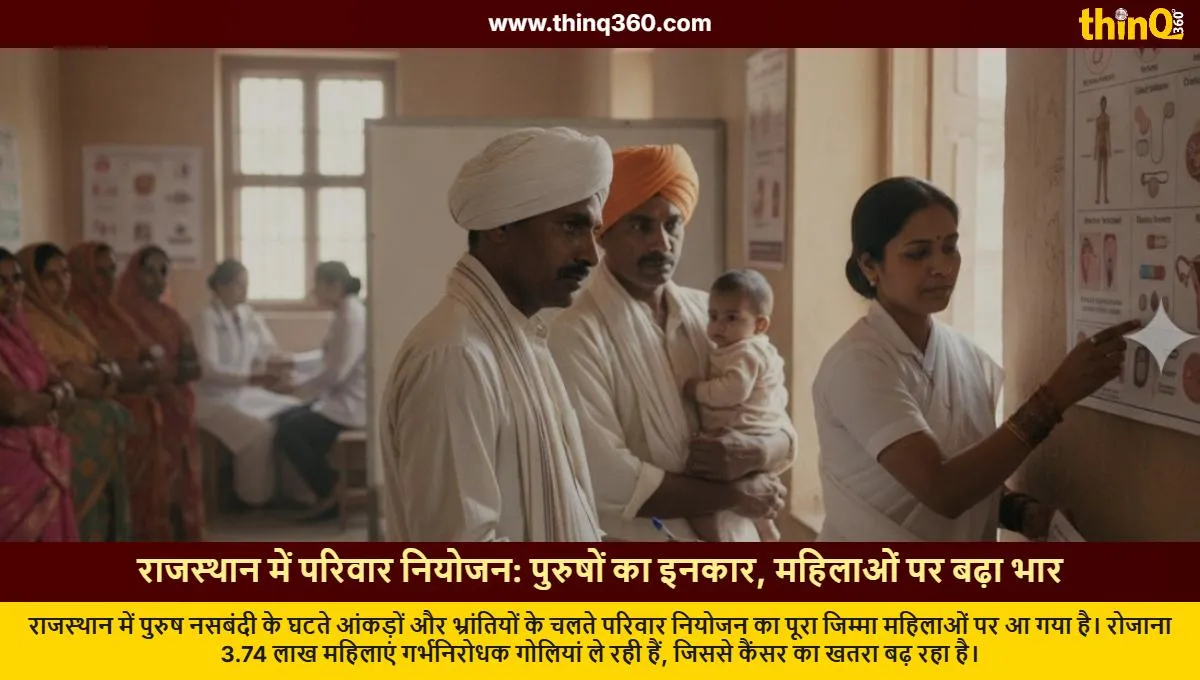
In Rajasthan, the responsibility for family planning has largely fallen on women.
Men are hesitant to undergo vasectomy due to myths and social misconceptions.
Approximately 3.74 lakh women in the state consume contraceptive pills daily.
Prolonged use of these pills increases the risk of breast and cervical cancer in women.
Jaipur | In Rajasthan, the burden of family planning has completely shifted onto the shoulders of women. Due to a patriarchal mindset and prevalent myths, men are shying away from vasectomy, and lakhs of women are paying the price with their health. Around 3.74 lakh women in the state are forced to consume contraceptive pills daily.
Gender Inequality in Family Planning
Government efforts to control the growing population are proving insufficient without the participation of men. In a male-dominated society, family planning has been deemed a woman's issue.
Data shows that the number of male vasectomies is decreasing year by year, while the number of women adopting contraceptive methods is continuously rising.
Several misconceptions about vasectomy are prevalent among men. They believe that the operation will reduce their physical and sexual prowess.
Additionally, men engaged in physical labor fear that they will be unable to work for an extended period after the surgery. These myths lead them to push women to the forefront.
Double Burden on Women's Health
The entire responsibility of spacing births and limiting the family size has been placed on women. For this, they have to resort to temporary methods like contraceptive pills.
According to health experts, "Long-term use of contraceptive pills can increase the risk of breast and cervical cancer in women. This is a serious health concern."
Health department figures confirm this grim situation. In 2022, 3.79 lakh women were consuming these pills, and this number has remained around 3.74 lakh by 2025.
This situation illustrates how a temporary solution is turning into a permanent health risk for women. The goal of family planning is incomplete without male participation.
This is a major challenge on both social and health fronts. The problem can only be solved by spreading awareness in society and making men realize their responsibility, thereby freeing women from this double burden.

 बलजीत सिंह शेखावत