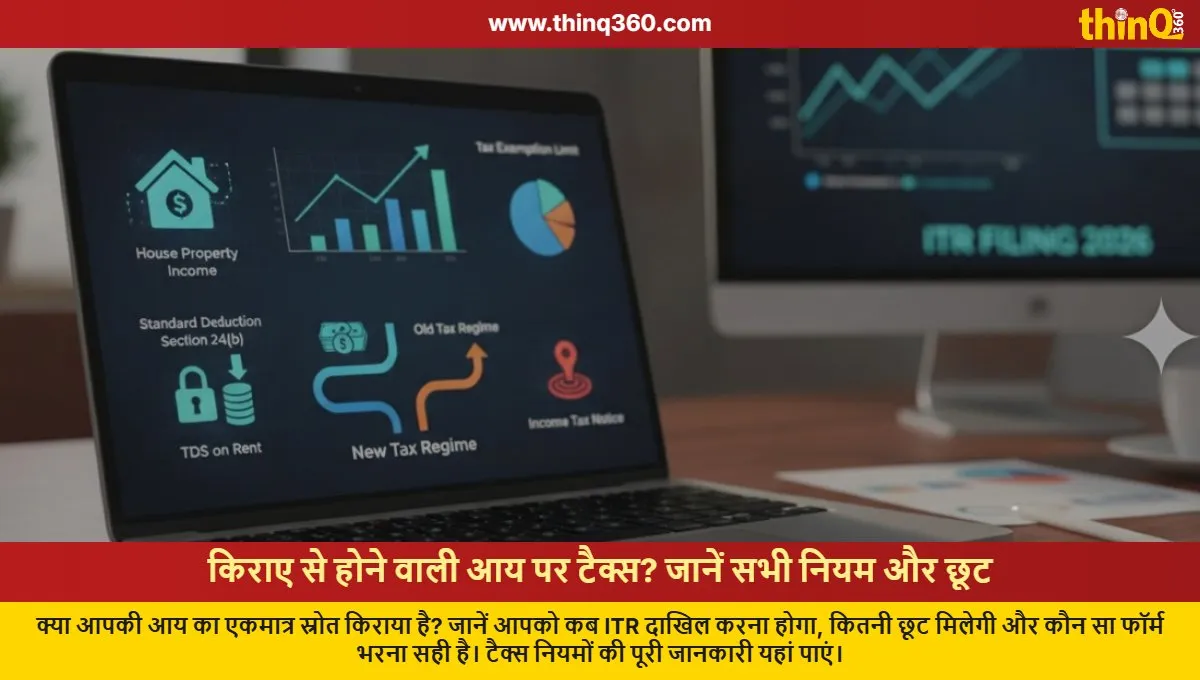
Filing ITR is mandatory if your rental income exceeds the basic exemption limit.
The Income Tax Department allows a 30% standard deduction on total rent for repairs and maintenance.
Interest on a home loan can also be claimed as a deduction under Section 24(b) of the Income Tax Act.
ITR-1 form is for income from one property, and ITR-2 is for more than one property.
New Delhi | Many landlords assume that if their only source of income is rent, they do not need to file an Income Tax Return (ITR). However, this is a major misconception that can lead to penalties and tax notices in the future.
The Income Tax Department does not consider how many sources your income comes from, but whether your total income exceeds the tax exemption limit.
Even if your sole income is from rent, you will have to file an ITR. It is mandatory to file a return if your gross total income exceeds the basic exemption limit.
However, the tax is not calculated directly on the entire rental amount. First, the taxes paid to the municipal corporation are deducted from it.
Deduction Rules
After this, a lump sum standard deduction of 30 percent is available on the remaining amount for repairs and maintenance.
Additionally, if the house was purchased with a home loan, a deduction can also be claimed on the interest paid under Section 24(b) of the Income Tax Act. Your tax liability is determined on the amount remaining after all these deductions.
New vs. Old Tax Regime
It is mandatory to file a return if the annual income exceeds ₹3 lakh under the new tax regime and ₹2.5 lakh under the old regime.
Deepashree Shetty, a partner at BDO India, explained that the difference between the two regimes is not just the exemption limit.
In the old regime, any loss from house property can be set off against other income, whereas this facility is not available in the new regime.
Therefore, taxpayers should choose a regime only after analyzing their entire financial situation, rather than just looking at the exemption limit.
Choosing the Right ITR Form
Selecting the correct form is also very important. If a person's income is from only one property and the total income is less than ₹50 lakh, they should file the ITR-1 (Sahaj) form.
However, if the source of income is two or more properties, they must use the ITR-2 form. The last date to file both these forms is July 31, 2026.

 जोगेन्द्र सिंह शेखावत